
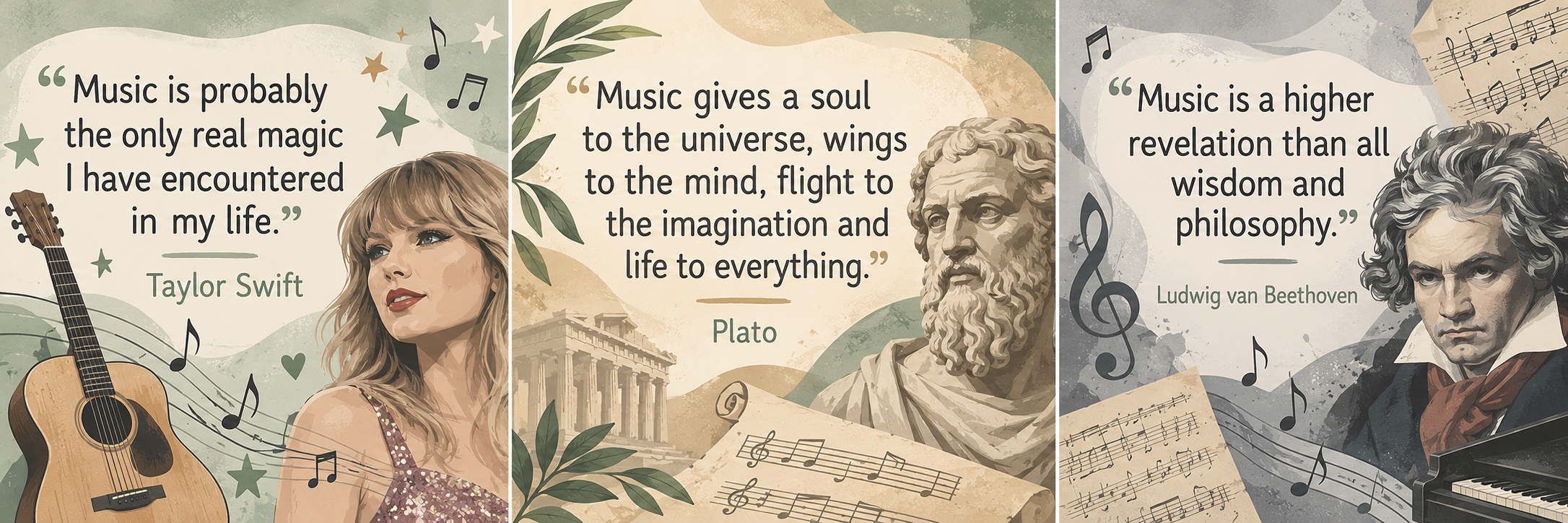
At our school, music is a joyful and creative subject that allows children to express themselves and discover their talents.
We want children to enjoy listening to, creating and performing music, while developing confidence and a love of music that stays with them for life. Through music, children explore sounds, rhythms and melodies from different times, cultures and traditions, helping them to understand the world and their place within it.
Music lessons are lively, practical and inclusive. Children learn to sing, play instruments, compose and perform, working both independently and with others. They are encouraged to listen carefully, share ideas and reflect on their own music and the music of others.
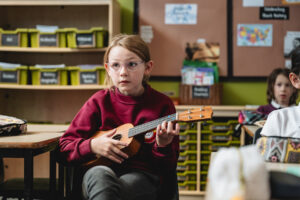
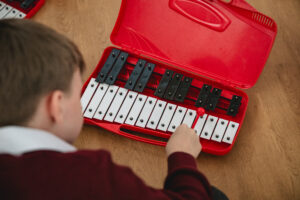
We bring music to life through hands‑on experiences, performances and specialist teachers. Children have the opportunity to learn an instrument, perform in assemblies, take part in concerts or workshops, and experience live music that inspires and motivates them. Practical learning is at the heart of our music teaching. Pupils enjoy experimenting with instruments, voices and digital music tools, exploring how music is created and how it can change mood and tell a story. They learn to use musical language such as pulse, rhythm, tempo, pitch and dynamics with growing confidence.
As children move through the school, they build their musical skills and understanding, learning to listen carefully, perform with confidence and work collaboratively. They explore different styles of music and begin to understand how music reflects different cultures, times and emotions.
By the time pupils leave our school, we want them to have a strong enjoyment of music, confidence in performing and creating, and an appreciation of music as a powerful way to express ideas, emotions and creativity.
At Darton Primary School, our Design and Technology curriculum aims to inspire children to become creative, innovative and confident problem-solvers. Through a carefully sequenced curriculum, pupils develop the knowledge, skills and understanding needed to design, make and evaluate products that solve real and relevant problems. We aim to nurture curious and resilient learners who are willing to take risks, learn from mistakes and use their imagination to bring ideas to life. By exploring a range of contexts, materials and technologies, children develop an appreciation of how design and technology impacts everyday life and shapes the world around them.
Through engaging, practical learning experiences, pupils develop the skills to investigate, design, create, test and refine products for a purpose. They work with a variety of materials and components, including structures, mechanisms, textiles, food and electrical systems, applying their learning to meaningful projects. Our curriculum encourages children to think critically, communicate ideas effectively and evaluate products against design criteria, developing an understanding of the design process from concept to completion. Pupils are also introduced to the work of designers, engineers, inventors and chefs, helping them to recognise the importance of creativity, innovation and technology in modern society. Our curriculum reflects our school values of inclusion, positivity, kindness, respect, honesty and curiosity, ensuring that every child is supported to develop their confidence, practical skills and creative thinking.
Ultimately, we want our children to leave Darton Primary School with a strong foundation of design and technological knowledge, the confidence to approach challenges creatively and the resilience to refine and improve their ideas. We aim to nurture innovative thinkers and responsible future citizens who understand how design can improve lives and solve problems, ready to Aim High, Work Hard, Achieve Together.
Our Music curriculum is delivered through discrete lessons and is underpinned by the HCAT Accelerated Learning approach to teaching and learning. Through a carefully sequenced curriculum, children develop the knowledge, skills and understanding necessary to become confident performers, composers, listeners and musicians.
The key concepts, knowledge and skills are derived from the National Curriculum and mapped progressively across the school to ensure clear progression from EYFS to Year 6. Through singing, performing, composing, improvising and listening, pupils develop their musical understanding while building creativity, confidence and self-expression. Our curriculum equips children with the cultural awareness, collaboration and communication skills needed to thrive in the 21st century.
Music at Darton Primary School is designed to be inclusive, ambitious and engaging for all learners. A rich and varied range of musical experiences enables every child to participate, succeed and develop a love of music. Learning can be adapted to meet the needs of individual pupils, ensuring that all children can access and enjoy the curriculum while achieving their full potential.
The Accelerated Learning Cycle, based on the work of Alistair Smith, is embedded throughout our teaching. This approach creates a supportive yet challenging learning environment where pupils actively engage in learning through practical, multi-sensory experiences. Opportunities to revisit prior learning, demonstrate understanding in different ways and consolidate knowledge ensure that learning is meaningful and retained over time.
Across school, a Gather, Skills, Apply approach is used to plan and deliver lessons:
This approach enables pupils to develop a deep understanding of musical concepts and apply their learning confidently in a variety of contexts.
Formative assessment is an integral part of every lesson. Teachers continuously assess pupils’ understanding through observation, questioning, discussion, performance and practical participation. This allows teaching to be adapted responsively to meet the needs of all learners, address misconceptions and provide appropriate challenge and support.
Through regular assessment, activities are carefully matched to pupils’ abilities, with differentiation, targeted adult support and effective questioning ensuring all children can make strong progress. By building knowledge sequentially and providing meaningful opportunities to perform, compose and evaluate music, pupils develop as confident, creative and reflective musicians.
 .
 .