
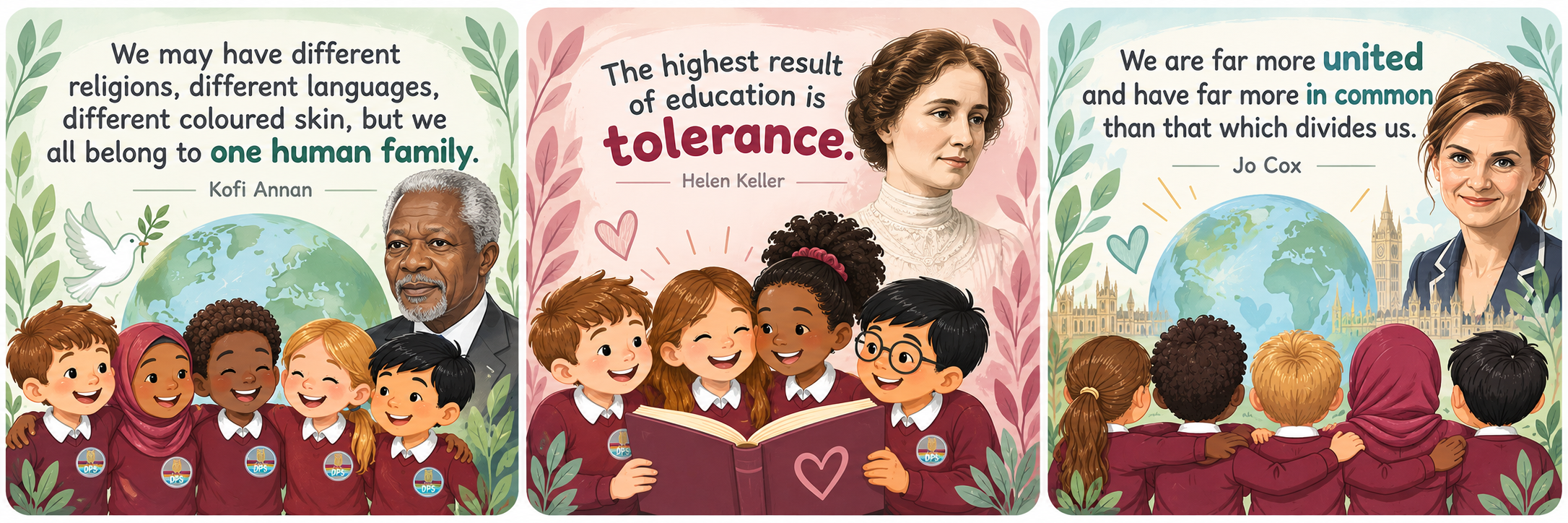
At our school, Religious Education is an exciting opportunity to explore beliefs, values and ways of life from different religions and worldviews. We want children to develop an understanding of themselves and others, whilst appreciating the diversity that exists within our local community, the United Kingdom and the wider world.
We encourage children to be curious learners who ask thoughtful questions, share their ideas and reflect on their own experiences. Through discussion, enquiry and exploration, pupils learn about different beliefs, traditions and practices, helping them to develop respect, tolerance and empathy for others. RE lessons are engaging and memorable, enabling children to make sense of the diverse world in which they live.
We bring learning to life through visits to places of worship, visitors from different faith and belief communities, workshops and special themed events. Children may visit a church, mosque, temple or synagogue, speak to people about their beliefs, or take part in activities that deepen their understanding of different religions and cultures. These experiences help pupils make meaningful connections between their learning and the real world.
Discussion and reflection are at the heart of our RE curriculum. Pupils are encouraged to explore big questions about life, belonging, morality, identity and faith. They learn to listen respectfully to different viewpoints, consider a range of perspectives and express their own opinions with confidence and sensitivity.
As children move through the school, they build a secure understanding of a range of religions and worldviews, exploring both similarities and differences between them. They develop knowledge of key beliefs, celebrations, symbols and teachings, while also considering the values that unite communities and shape society.
By the time pupils leave our school, we want them to have a strong understanding of different religions and worldviews, confidence in discussing important questions and issues, and the respect, curiosity and open-mindedness needed to thrive in a diverse and ever-changing world.
At Darton Primary School, our Religious Education curriculum aims to inspire children to develop a lifelong curiosity about different religions, beliefs and worldviews, whilst fostering respect, empathy and understanding for others. Through a carefully sequenced curriculum, pupils develop a secure understanding of a range of religious and non-religious worldviews, exploring how beliefs, values and traditions influence the lives of individuals and communities. We aim to develop thoughtful, reflective and knowledgeable learners who ask questions, explore different perspectives and develop an appreciation of the diversity that exists within our local community, the United Kingdom and the wider world.
Through engaging, active learning experiences, including visits to places of worship, encounters with faith communities, the exploration of artefacts, stories and sacred texts, and opportunities for discussion and debate, pupils develop the skills to investigate, reflect and communicate their understanding. Our curriculum encourages children to explore key concepts such as belief, identity, belonging, faith, morality and community, helping them to make meaningful connections between their learning and the world around them.
Pupils are encouraged to consider important questions about meaning, purpose and values, whilst learning to appreciate both similarities and differences between religions and worldviews. Through respectful dialogue and reflection, children develop the confidence to express their own ideas and opinions while valuing those of others. Our curriculum reflects our school values of inclusion, positivity, kindness, respect, honesty and curiosity, ensuring that every child feels valued and supported in their learning.
Ultimately, we want our children to leave Darton Primary School with a secure understanding of a range of religious and non-religious worldviews, the confidence to discuss and reflect upon complex ideas, and a deep respect for diversity. We aim to nurture responsible, informed and compassionate citizens who are open-minded, reflective and prepared to contribute positively to an increasingly diverse and interconnected world, ready to Aim High, Work Hard, Achieve Together.
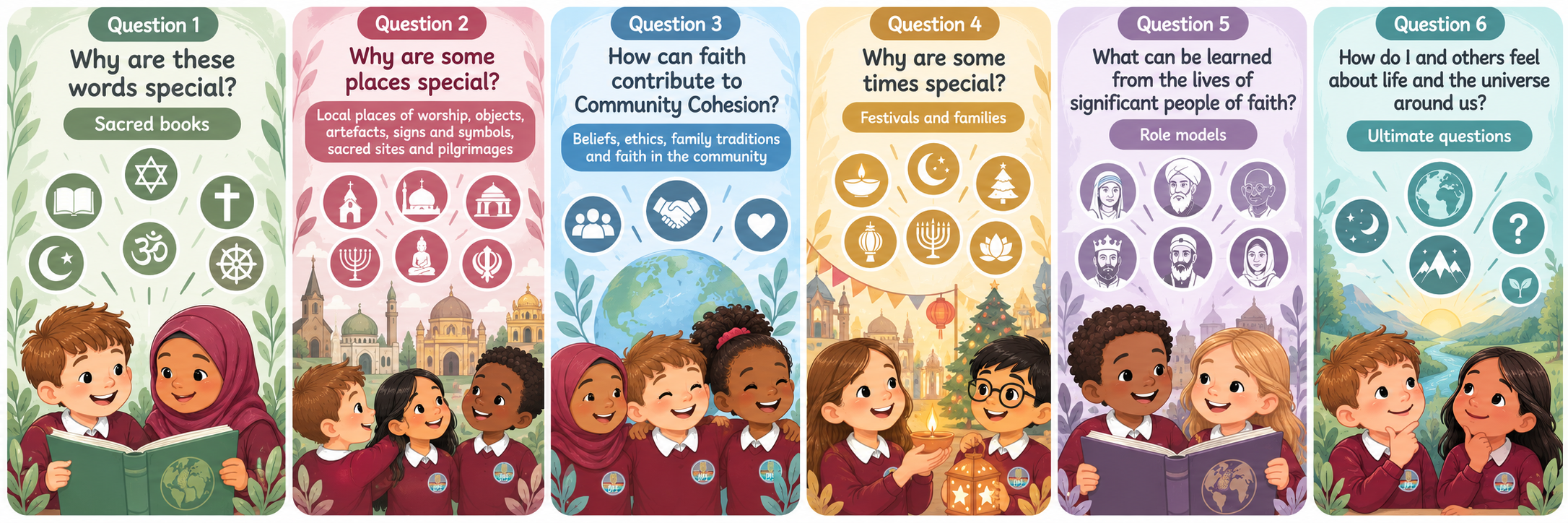
Religious Education is taught as a discrete subject through engaging, thought-provoking lessons that inspire curiosity, reflection and discussion. As a mixed-age school, RE is delivered through a carefully planned two-year curriculum cycle, ensuring full coverage of the Barnsley Agreed Syllabus whilst allowing pupils to revisit and deepen their understanding of key concepts over time. Learning is structured around the six key questions within the syllabus, providing clear progression throughout each child’s RE journey at DPS.
As pupils move through the school, they develop their ability to:
Active learning is central to our RE curriculum. Through discussion, debate, enquiry, role play, storytelling, investigation and collaborative activities, pupils are encouraged to think deeply and engage meaningfully with their learning. Children explore artefacts, religious texts, symbols, artwork and real-life experiences to develop a rich understanding of beliefs and practices. Visits, visitors and first-hand experiences further enhance learning, helping pupils make meaningful connections between religions, worldviews and life in modern Britain.
The Accelerated Learning Cycle, based on the work of Alastair Smith, is embedded across the curriculum. This approach promotes active participation, investigation and reflection, enabling children to develop a secure understanding of key concepts while making connections between prior learning and new knowledge.
We place great importance on helping children “know more and remember more”. Key knowledge is revisited across the two-year cycle to strengthen retention and build understanding progressively. Pupils are encouraged to confidently articulate what they have learned and apply their knowledge when discussing different religions, beliefs and worldviews.
Assessment in RE is ongoing and informs future teaching and learning. Through questioning, discussion, written work, practical activities and pupil reflection, teachers regularly assess understanding and adapt learning to ensure all pupils can access and succeed within the curriculum. Curriculum leaders regularly review assessment information to identify strengths, address misconceptions and ensure learning builds effectively over time.
Reflection is a fundamental aspect of Religious Education at DPS. Pupils are encouraged to consider a range of viewpoints, justify their opinions and engage respectfully with the beliefs and perspectives of others. Through this reflective and enquiry-based approach, children develop confidence, empathy and a deeper appreciation of the diverse communities and worldviews that shape our society.
By the time they leave DPS, pupils will have developed a secure understanding of a range of religious and non-religious worldviews, alongside the knowledge and skills needed to think critically, ask thoughtful questions, debate respectfully and value diversity in an increasingly interconnected world.
Parents and carers have the legal right to withdraw their child, either wholly or partly, from Religious Education (RE) lessons. We encourage families to discuss any concerns with the school before making this decision so that we can explain the curriculum and answer any questions. If a parent chooses to withdraw their child from RE, alternative supervised activities will be arranged during lesson times. Requests for withdrawal should be made in writing to the Head of School. We are committed to respecting the beliefs, values and backgrounds of all members of our school community.